Fi‑Wi Indoor Fiber to Wireless
Doing what’s thought impossible: scheduling 802.11 transmissions over unlicensed spectrum, so an operator can deliver low latency and responsiveness indoors.
The end-to-end goal of networking is simple to state: copy a message from the memory of one machine to the memory of another. Every layer between is an implementation of that copy, and each layer re‑quantizes it into its medium’s natural unit(s).
Networking solved the wired path decades ago. Routers gave the core topology and a forwarding plane that thinks in IP packets, and Ethernet switches gave the building one that thinks in 802.3 frames, abolishing the shared medium rather than managing it. The air never received the equivalent. Wi‑Fi still arbitrates one transmission at a time, for every device, in every room, so the queues that decide what a person actually experiences form on the wireless hop that nothing schedules.
Each plane handles a message in its medium's native unit, and the air charges per transmission, not per packet. The third plane is the one 802.11 never received; the first two are solved, and a message's fate end to end now turns on the third.
Not shown: the operator's outside plant. It is scheduled too, a PON or DOCSIS scheduler granting upstream windows to each subscriber, but on a medium the operator owns. The unlicensed air is where the scheduling stops today, and what Fi‑Wi addresses.
What is Fi-Wi
One building-wide concentrator, fiber out to abundant 802.11 radio heads, and abundant inexpensive radio sensors that continuously measure the wireless hops. Scheduled centrally, on commodity silicon using unlicensed spectrum. It serves the tens of billions of Wi‑Fi devices already deployed.
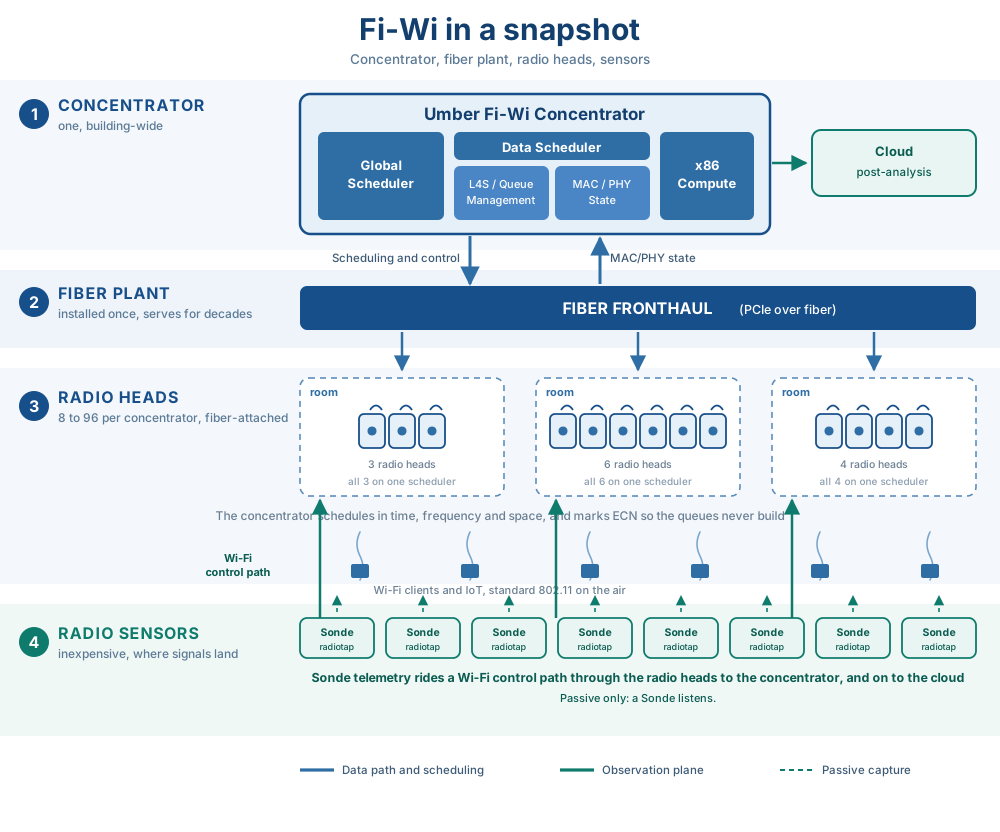
Fi‑Wi architecture: a concentrator, a fiber plant, abundant radio heads, abundant sensors.
The fiber plant is the durable asset: installed once, it serves the building for decades, to 1 terabit/sec and beyond. The radio heads and the sensors are the replaceable parts, inexpensive and swapped as standards move; the heads keep their 802.11 MAC and PHY and stay standard on the air. The concentrator is where the intelligence lives, and it does two things. First it makes each domain schedulable, deciding every transmission in time, in frequency and in space: which head sends, in which slot, on which allocation, and how transmissions are kept spatially separate. One entity deciding service order is what gives a queue there any meaning. Then it marks. It holds every payload in its own DRAM, one bottleneck queue per scheduled domain, and marks ECN on each, so senders back off before they build.
The fronthaul is PCIe extended over fiber: the concentrator builds the descriptor rings, the head starts the DMA, and the aggregate is pulled straight out of that DRAM and streamed through a small speed-matching FIFO to the air. The payload rests nowhere else, so bufferbloat has no second place to form. That is what lets L4S and other ECN-based congestion control work across the wireless hops.
Grants govern when an A‑MPDU becomes eligible to enter the 802.11 MAC, which contends for the medium as it always would. Congestion control governs how much. A paced sender and a window-limited, ACK‑clocked one do not respond alike to the same grant, which is among the things the measurements are there to settle.
The Sonde sensors see what humans cannot. They capture passive radiotap telemetry at the points where signals land and from where they originate. The Fi‑Wi telemetry, correlated centrally, becomes inputs to the Fi‑Wi forwarding plane. There is a path to sensing built into future radio-head platforms.
What Fi-Wi takes on
The contended wireless segment of the access path. The operator owns the customer experience, and Fi-Wi extends that ownership through the air interface: the last segment to come under a central schedule.
Why now: fiber is the durable plant, and it is cheapest installed soonest.
Fiber install costs are driven by labor rates, and labor rates rise. The same build costs less today than it will later, and it serves for decades either way.
It is also the most durable indoor plant. The same fiber carries Ethernet, DWDM or PCIe, so it is not tied to an application the way a copper category is. Cat5 becomes Cat6, then Cat7, then Cat8, each one a rip-and-replace; fiber installed once carries whatever comes next.
There is a second clock. 6 GHz low power indoor mode trades range for density, often requiring more radios for contiguous indoor coverage. As radio density rises, coordination becomes increasingly important. It lands first in multi-dwelling buildings, student housing, hotels and other dense indoor environments, and it does so on unlicensed spectrum, without paying billions in spectrum auctions.
Measure it first
Umber is a measure-it-first company, founded by Bob McMahon, who created and maintains iperf 2. The tools that characterise the problem come before the build. They are how an operator sees what the wireless segment is actually doing, and how the result gets checked afterwards.
 Get iperf 2 on Google Play.
The Android client, free, on the phone the
complaint came from.
Get iperf 2 on Google Play.
The Android client, free, on the phone the
complaint came from.
- iperf 2, with an Android client The industry-standard network performance tool. The Android client adds L4S testing at the endpoint.
- Sonde Captures what the MAC/PHY layer is doing at the points where signals land and from where they originate, simultaneously across the deployment.
- UAX-8 developer kit The 8-radio developer platform for Fi-Wi’s C-RAN-style centralized MAC scheduling architecture. Configure and order it in the store, which needs an account.
Read the work
- Fi-Wi Forwarding Plane v2 The technical paper, and ground truth for the architecture.
- Contended Access Scheduling Protocol (CASP) for 802.11 networks The problem statement and the direction proposed for it, as put to the IETF.
- A Forwarding Plane for In-Building Wireless The IETF 127 hackathon plan.
- Physical AI Why causal observability is the prerequisite for learning, and what the scheduler actually does.
Schedule a demo
See a concentrator scheduling live traffic across radio heads, with Sonde telemetry running alongside it. Write to sales@umbernetworks.com and say what you would like to see.
Investing
The investment case, the milestone plan and the financials sit behind an account, and investors get their own view of them. Write to info@umbernetworks.com and we will set one up. The investing page has the full picture.
Shares issued by Umber may qualify for qualified small business stock treatment under Section 1202, subject to the applicable requirements. Investors should consult their own tax advisors.
This page describes the company. It is information about Umber Networks, and it is not an offer to sell securities. Any investment is made through the executed round documents. Statements about plans, milestones and financing are not forecasts or guarantees, and actual results may differ materially.
Sign in for the full library
Engineering, advisory, customer and investor material sits behind an account, and signing in takes you straight to your own view of it. Account holders can also configure and order UAX‑8 systems and Sonde probes in the store. Accounts are provisioned individually. Write to info@umbernetworks.com and say which material you need.